

Where Care Happens
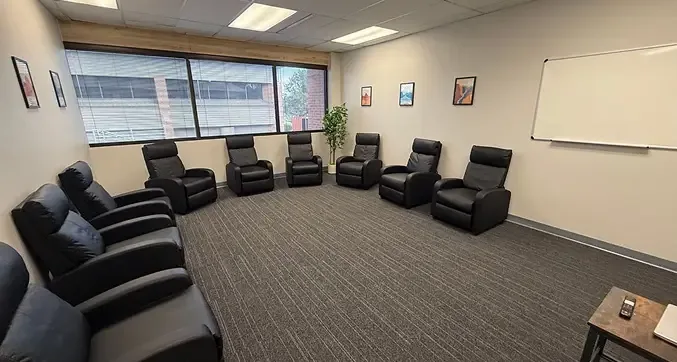
Our facility provides private, confidential spaces where families can focus on healing without distractions. Families who can't make it to the office can join by secure video instead.
When someone you love starts treatment, the people around them are part of the recovery too. Family therapy in Colorado Springs at Drift Behavioral Health gives parents, partners, and other relatives a place to talk through what's happened and decide how to move forward together. Family sessions are part of our partial hospitalization (PHP) and intensive outpatient (IOP) programs for mental health and substance use. You'll learn how to talk without old arguments taking over. Each session also gives you something specific to practice at home.

Family therapy is counseling where the person in treatment and the people closest to them meet with a licensed therapist. The therapist looks at how the household works as a whole, including who handles conflict, who keeps the peace, and which conversations never seem to happen. At Drift, these sessions run alongside your loved one's PHP or IOP, so problems that surface at home can come up in treatment too. Some sessions include the whole family. Others involve only a parent or partner, depending on what the plan calls for.

Our family sessions are for the people who live with, care for, or love someone in treatment at Drift. That includes parents, spouses and partners, adult children, siblings, and anyone else your loved one counts as family. Many families come to us after months of worry over depression, anxiety, trauma, or alcohol and drug use. Family therapy for teens gives parents a direct role in their child's care, alongside the teen therapy each adolescent receives in our programs. For adults, family therapy in Colorado Springs gives partners and relatives a defined role, while your loved one stays in charge of their own recovery.

Real Google reviews from clients who started where you are now, in their own words.
Family counseling in Colorado Springs at Drift happens inside your loved one's treatment program. Their clinician works with them to decide when family sessions start, how often they happen, and who should attend. Sessions follow the same treatment plan your loved one uses in group and individual therapy. The details below cover where sessions take place, who leads them, and how each one runs.
Our facility provides private, confidential spaces where families can focus on healing without distractions. Families who can't make it to the office can join by secure video instead.
Our clinicians, including licensed clinical social workers (LCSWs), lead family sessions using cognitive behavioral therapy (CBT), dialectical behavior therapy (DBT), and family systems approaches. Sessions often touch on trauma and long-standing family patterns, at a pace your family can handle. You'll have room to bring up hard topics safely and practice new ways of sharing what you feel.
Sessions run 50–60 minutes with the whole family, smaller groups, or individuals as needed. You’ll gain practical skills, written materials, and specific exercises for difficult situations. Each session highlights clear goals and real-world practices you can try when not in therapy.
Complete assessment with your clinician covering family history, current challenges, and goals.
You'll get written goals for your family and regular check-ins on progress. Your therapist updates the plan as things change at home.
Your family therapist works with your primary care provider, medication team, and case manager, so everyone follows the same plan.
Try the skills from each session at home, even on calm days. When a hard moment comes up, write down what happened and how each person responded. Bring those notes to your next session, so your therapist has real examples to work with.
Research shows family therapy activities improve symptoms and keep people in treatment longer. This works for teens, adults, and even online sessions. Benefits include:
Calmer communication
Better follow-through at home
Stronger support for treatment
Better crisis management skills
Ways to support without enabling
Methods for setting up healthy boundaries
Important limits: not for emergencies, requires active participation, and results vary by engagement level.
For mental health emergencies or suicidal thoughts, contact emergency services immediately.

Family therapy in Colorado Springs is part of every program at Drift, for adults and teens. Teen programs add parent workshops and caregiver sessions on top of regular family work.
Our mental health PHP and intensive outpatient program both include weekly family work, skill building, and care coordination. PHP meets five to six days a week for about five hours a day, and IOP takes fewer hours each week. Family sessions cover communication patterns, crisis planning, and what support will look like once structured treatment ends. If your loved one lives with depression, anxiety, or another mental health condition, these sessions show you how to support them day to day.
Family therapy is core to teen PHP and IOP, with smaller groups, parent workshops, and consistent caregiver sessions. We focus on skills, safety, and school-life balance.Our teen programs include coordination with schools and other providers in your teen's care. This encourages integrated care that supports individual needs.
Addiction changes how a family works. One person covers for missed shifts, another keeps the peace, and someone else stops talking about it at all. Family therapy for addiction helps each person see the role they've taken on and how it affects the person in recovery. Those patterns usually formed to get through a hard stretch, so nobody is blamed for them. A 2025 article in Frontiers in Public Health points to research linking family involvement in substance use care to stronger treatment engagement and lower dropout rates.
Sessions will also address boundaries. This may feel awkward at first. Your therapist will walk you through what you will and will not do, such as no longer paying bills incurred due to drinking/drug use and how to communicate this matter-of-factly. You will learn warning signs of relapse to look for going forward, such as missed meetings, visits with using friends, and sudden anger. Identifying these signs and triggers ahead of time gives your family time to respond and have a plan in place. All of this work lowers the chance of relapse when your loved one is no longer in a structured care environment.
At Drift, family sessions are part of our addiction PHP and IOP from the start. Sessions also explain how substance use changes the brain, so the behavior you've seen at home starts to make more sense. When medication-assisted treatment is part of the plan, your family learns how buprenorphine or naltrexone works and what to expect. If your loved one needs detox first, our admissions team helps find a detox program through partner facilities, with same-day reviews.

When families are unable to access care at our office, they can receive care via secure Zoom video sessions with their assigned therapists and clinical team. We provide telehealth services to clients across Colorado. Family members can participate from home or work. Online sessions can be a great fit for many families. For example, when a parent works overnight shifts or your sibling lives in the opposite region of the state. Video sessions allow you to skip the commute and time away from work or school. You can switch between online and in-person care (or vice versa) if your circumstances change.

Drift works with many private insurance plans, and family sessions within PHP or IOP may be covered. Your coverage depends on your specific plan, including deductibles and copays. Once you verify your insurance online, our admissions team checks your benefits before treatment starts and explains what your plan may cover. We don't accept Medicaid or Medicare, and self-pay options are available.






Medicaid and Medicare are not accepted. Self-pay options are available.
Families choose Drift for practical reasons as much as clinical ones. Our family therapy in Colorado Springs is close to home, fits busy schedules, and includes hands-on support between sessions.
Our office is at 5446 N Academy Blvd, Suite 102, in Colorado Springs.
Sessions run during the day and in the evening, Monday through Saturday, so working parents and partners can attend. Our mental health IOP is built to fit around jobs, school, and family schedules.
A case manager helps with practical needs during treatment, including transportation help and coordination with outside providers. They also plan each step down in care, such as moving from PHP into our addiction IOP or a mental health IOP. If a higher level of care is needed, they help arrange an inpatient placement. Before discharge, they help build an aftercare plan for your loved one and your family.