

Home / Adolescent Program / Levels of Care for Adolescents in Colorado Springs / Adolescent PHP in Colorado Springs
Adolescent PHP in Colorado Springs
The attendance office calls again, your teen’s bedroom door stays shut, and you have used your days off work. You cannot tell whether it is mood, substances, or both. The word hospitalization also sounds bigger than anything you meant to ask for. At Drift Behavioral Health, we offer adolescent PHP in Colorado Springs for teens ages 13 to 17. Groups are small and clinician-led, and your teen sleeps at home.

Why Early Intervention Matters for Teens
Brain development continues well into early adulthood, notably in regions involved in decision-making, impulse control, and emotional balance. As these regions continue to mature, your teen may respond to stress without fully weighing long-term consequences. According to NIDA, early use of alcohol and other substances can increase the likelihood of a substance use disorder and can affect brain development.
Beyond biology, your teen navigates academic expectations, peer influence, digital pressures, and family dynamics. When depression, anxiety, trauma, or attention difficulties are present, substances may appear to relieve distress temporarily. Without timely guidance, experimentation can evolve into repeated use.
Starting early gives your family time to build skills before patterns settle. A teen partial hospitalization program in Colorado Springs lets our clinicians provide daily therapeutic support and monitor progress before challenges intensify.
Our Partial Hospitalization Program (PHP) is the most intensive form of outpatient care available for adolescents. It provides structured daytime treatment for teens who require close supervision but can safely return home each evening. This level of care bridges the gap between inpatient treatment and traditional outpatient therapy by offering consistent therapeutic support without 24-hour residential placement. Some families know PHP as adolescent day treatment.
Our adolescent PHP in Colorado Springs serves teens who experience substance misuse and other adolescent mental health conditions. Some teens come to us after completing residential treatment or detox, while others enroll when weekly counseling no longer provides adequate support. In each case, PHP delivers daily therapeutic involvement and focused interventions designed to improve overall functioning.
The program operates Monday through Friday for approximately five to six hours each day. Most teens participate for two to six weeks, depending on clinical progress and individualized goals. This defined schedule provides consistent daily engagement while allowing your teen to return home in the evenings.
Clear expectations, predictable routines, and steady attendance requirements help create accountability and measurable progress throughout the course of care. This structured format allows our clinicians to monitor your teen’s response to treatment closely and revise plans as needs evolve.
A Day in Our Adolescent PHP
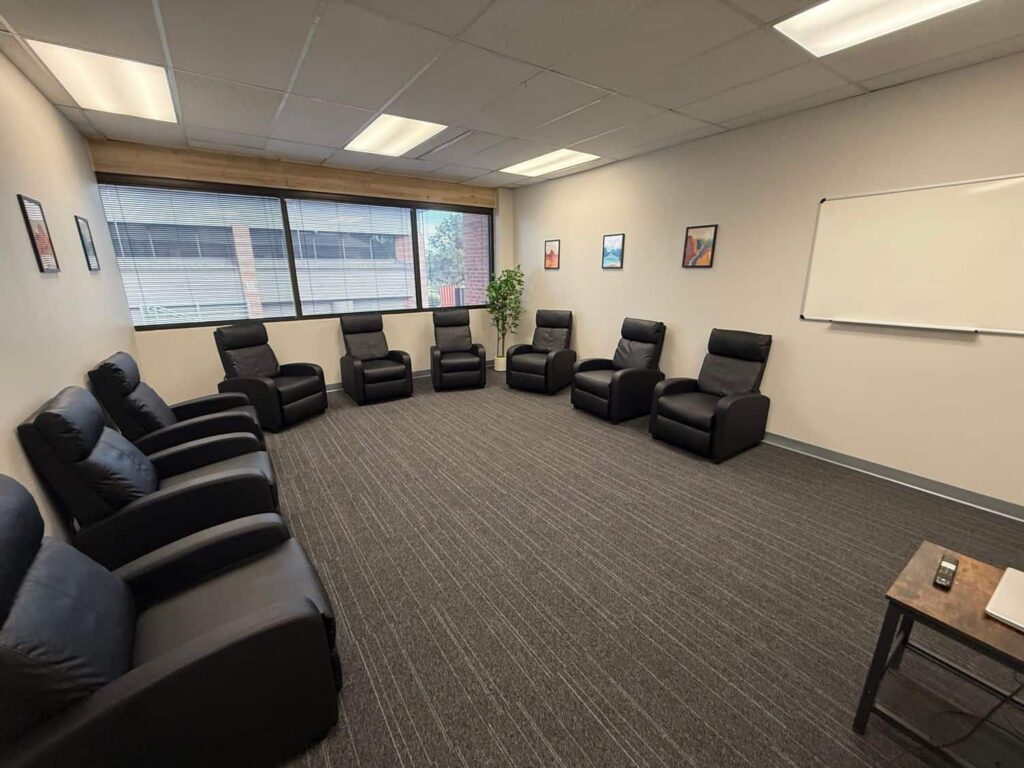
Each treatment day follows a consistent flow so you know what to expect. Each day begins with a structured check-in where your teen reviews goals and identifies current challenges. Group sessions then address skill development in areas such as communication, emotional awareness, problem-solving, and behavioral choices.
Your teen also attends individual counseling to work on personal objectives and receive direct feedback. When appropriate, the schedule includes supervised academic time to help your teen stay aligned with school responsibilities. Before dismissal, our staff guides your teen in identifying practical ways to apply learned strategies at home, reinforcing continuity between treatment and daily life.
Integrated Dual Diagnosis Care
When your teen is dealing with both substance misuse and mental health conditions, coordinated clinical care matters. Treating these concerns separately often leads to incomplete improvement. An integrated model guarantees that our providers evaluate how emotional symptoms and substance use patterns interact and influence one another.
Our teen dual diagnosis treatment approach unites Cognitive Behavioral Therapy (CBT), Dialectical Behavior Therapy (DBT), and trauma-informed interventions within a unified plan. Our clinicians conduct comprehensive psychiatric assessments and, when appropriate, oversee medication management.
Family Participation
Your involvement holds an important role in your teen’s long-term progress. Teens respond more positively when families reinforce therapeutic tools at home. Consistent communication between our clinicians and you also helps keep expectations clear across treatment and home environments. For this reason, our team actively includes you in the treatment process.
Weekly family sessions address communication, boundaries, and conflict resolution. Educational meetings give you insight into behavioral health conditions and substance misuse. As discharge approaches, you collaborate with our clinicians to create a detailed aftercare strategy. This partnership supports sustained improvement and smoother transitions after program completion.
How PHP Works Around School
Treatment should not derail your teen’s educational progress. When appropriate, our staff communicates with school personnel to support continuity in coursework. We can also provide paperwork or records for your teen’s school. Scheduled study periods during program hours help your teen stay on track with academic expectations and minimize missed assignments. This approach lowers academic pressure while your teen focuses on improving their mental health.
Clinicians also evaluate how school-related stress affects your teen’s mental health. When necessary, your teen learns organization techniques, time management strategies, and healthy study habits. Our staff reinforces these skills throughout the program so your teen can apply them consistently in the classroom. This adolescent day treatment format promotes psychological growth while protecting educational momentum.
Admissions Process
Enrollment starts with a comprehensive clinical evaluation. During this process, our providers review your teen’s psychiatric history, substance patterns, safety concerns, and functional impairments. The assessment determines whether partial hospitalization represents the appropriate intensity of care.
If medical detoxification or inpatient stabilization is required beforehand, we coordinate referrals to trusted facilities. You are welcome to call our center for guidance through the intake process.
What Parents Can Expect in the First Week
Your teen may walk in unsure, or insisting nothing is wrong. Care can begin before your teen agrees there is a problem, and our clinicians start from wherever your teen is. Once your teen joins our teen partial hospitalization program in Colorado Springs, the first thing that matters is who they work with.
Each teen is paired with a dedicated therapist and case manager, so they have the same two familiar people to turn to throughout treatment. You’re part of that team too. If you notice changes in your teen’s behavior at home, let us know so their clinicians can factor it into care.
Stepping Down to IOP
Adolescent IOP is the step-down option for teens finishing our partial hospitalization program for adolescents who can continue care while living at home and attending school. It meets three to five days a week, which is a lighter schedule than PHP. It is also designed around school schedules.
The move is a clinical decision made with your family. Your teen’s progress and individual goals guide it. Timing differs from one teen to the next.
Your teen keeps the core pieces of care in Adolescent IOP: clinician-led group therapy, one-on-one counseling, and medication management when it is indicated.
Aftercare plans include relapse prevention tools, referrals to community providers, and alumni resources. Those give your teen and your family people and tools to rely on after the program ends.
Paying for Adolescent PHP: Plan Types and Verification
At Drift, we work with PPO, POS, EPO, and HMO plans. Private pay and self-pay are also available. We do not accept Medicaid or Medicare.
Coverage depends on your plan, and PHP may be covered. You can check your insurance benefits through our online form, which asks for your coverage type and member ID, or you can call us.
Our admissions team reviews your benefits and explains what your plan may cover before you decide. If you plan to pay privately, ask about self-pay when you call.
Our Approach in Colorado Springs
Our adolescent PHP in Colorado Springs brings mental health and substance use care together in one setting. Our clinicians with specialized experience in adolescent development facilitate small therapy groups that encourage participation and promote accountability. This specialized approach allows our providers to customize interventions to your teen’s developmental stage and clinical needs.
We also provide on-site psychiatric evaluation and medication oversight when clinically indicated. Virtual programming remains available for situations demanding flexibility. A clearly defined treatment plan guides your teen’s progress from admission through discharge.
When Is PHP the Right Choice?
Choosing the right level of care can feel challenging when symptoms escalate. Our partial hospitalization program for adolescents increases daily therapeutic contact while allowing your teen to return home each evening.
You may want to consider PHP when:
- Weekly sessions fail to produce significant change
- Substance use increases in frequency or severity
- Mood instability interferes with academic performance
- Impulsive or aggressive behaviors intensify
- Your teen transitions from residential treatment and requires continued support
Prompt intervention during these periods can reduce the risk of hospitalization and academic disruption. Your teen practices coping skills with a clinician in the room five days a week.
What Happens After You Reach Out About Adolescent PHP in Colorado Springs
At Drift Behavioral Health, we begin with a conversation. You message us and tell us what is happening with your teen. We answer your questions, start your benefit check, and set up a clinical evaluation. That evaluation guides which level of care fits, whether that is adolescent PHP in Colorado Springs or another level. You decide whether to go ahead, and you set the pace. Your teen’s school, your work schedule, and the cost of care are all fair questions to bring along. Contacting us commits you to nothing.
What Parents Want to Know About Adolescent Day Treatment
You know your teen best, and you want to get this right. These answers cover what parents ask us most about our adolescent day treatment.
Which Mental Health Conditions Does Adolescent PHP Treat?
Our adolescent program treats anxiety disorders, depression and mood disorders, ADHD, trauma and PTSD, and OCD. We also treat bipolar spectrum disorders, behavior and conduct concerns, and substance use. Teens come to us for mental health concerns on their own or alongside substance use. A substance use problem is not required to start.
What Does Medication Management Involve for a Teen?
Medication management is an ongoing clinician review of whether a medication helps your teen. It includes watching for side effects and adjusting the plan as your teen responds. It starts with a psychiatric evaluation, which reviews symptoms, history, and daily functioning. Medication is one part of a plan that also includes therapy sessions.
What Are Experiential Therapies in Adolescent PHP?
Experiential therapies are hands-on activities that support the work done in talk therapy. Our adolescent program includes yoga, meditation, music, art, and outdoor activities. They are offered alongside clinical therapies such as CBT and DBT. They give teens who struggle to put feelings into words another way to express them.
What Should I Do if My Teen Is in Crisis?
If your teen is in immediate danger, call 911 or the 988 Suicide & Crisis Lifeline at any hour. Safety planning is part of our PHP programming. If you are unsure whether it is an emergency, call 988 and describe what you are seeing. Share any safety concerns with our clinicians as they come up.
Where Is Your Adolescent Program, and Can My Teen Join Online?
At Drift Behavioral Health, our adolescent program is at 5446 N Academy Blvd, Suite 102, Colorado Springs, CO 80918. We offer virtual care at both the PHP and IOP levels. Teens join from home over a HIPAA-compliant, secure video platform. Virtual care is also offered as a step-down option after PHP.
Latest Resources

If you’re wondering, ‘Can generalized anxiety disorder be cured?’ The honest answer is that there’s no one-time cure for GAD. However, it is highly treatable. With professional treatment, many people

Does my teen have to admit they have a problem to get treatment? No. And that’s worth knowing, because waiting for that admission can mean waiting a long time. Denial

Research suggests telehealth IOP can produce outcomes comparable to in-person care for many people. Research comparing office-based and telehealth psychiatric IOP found comparable clinical outcomes and patient participation across both
Verify Your Insurance
Drift Website - Form - Verify Insurance
"*" indicates required fields